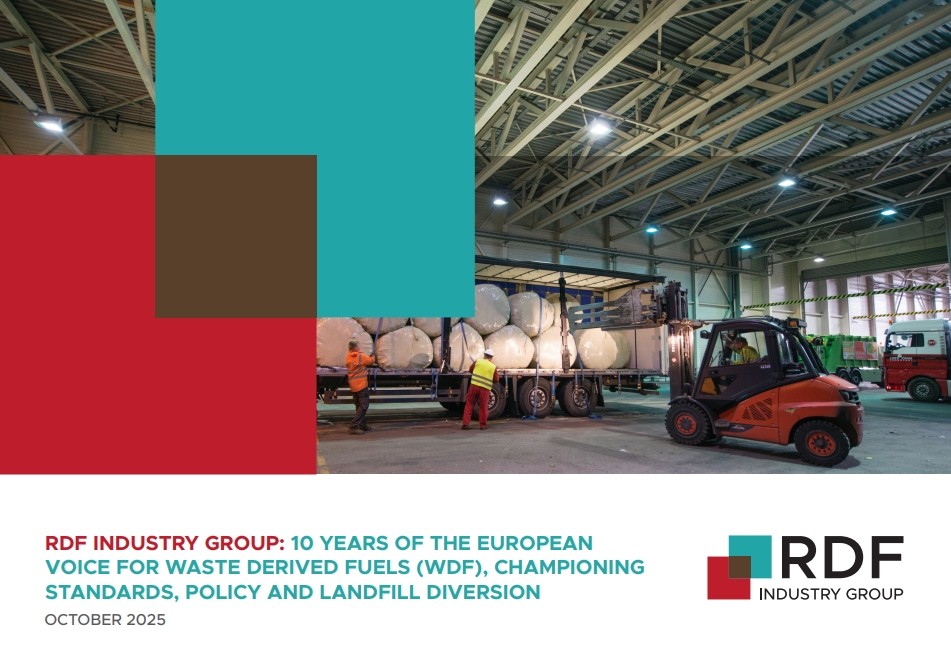
The RDF Industry Group marks its 10th anniversary with the release of a new report, “10 Years of the European Voice for WDF: Championing Standards, Policy and Landfill Diversion.”
The report highlights a decade of progress in transforming non-recyclable waste into a valuable low-carbon energy source, building a European market for waste-derived fuels (WDF). Since its launch in 2015, the Group has expanded to include more than 40 member companies, representing producers, logistics providers, testing services and energy-from-waste (EfW) operators across Europe.
“We saw not a collection of disparate national problems, but a single European challenge that demanded a collaborative, market-based solution. In doing so, we weren’t just ‘exporting waste’, but diverting it from landfill, allowing member states to collectively meet their environmental obligations in the most efficient way possible.”
— Andy Jones, Chair, RDF Industry Group
Over the past decade, the RDF Industry Group has played a central role in shaping the growth of the WDF market. What began as a UK-led export initiative is now a resilient European network, trading over 6.5 million tonnes of WDF annually. Through evidence-based advocacy, the Group has helped inform policy on landfill taxes, carbon pricing and waste shipment regulation, while promoting consistent operational standards and a responsible framework for cross-border trade.
The report highlights the significant environmental contribution of the WDF sector. Since 2015, exports have prevented an estimated 83.7 million tonnes of CO₂-equivalent emissions by diverting residual waste from landfill and enabling recovery in efficient EfW facilities across Europe, avoiding methane release.
Now entering its second decade, the RDF Industry Group is driving the next phase of progress in the waste-derived fuel sector, working collaboratively to advance decarbonisation, support carbon capture in EfW, and improve pre-treatment and fuel quality. It continues to champion high standards and a European approach to residual waste management that maximises efficiency, optimises infrastructure use and delivers shared environmental gains.